We get it. You play Old School RuneScape to click a rock and wait. You don't want to think about vectors, drag coefficients, or wind angles. But Sailing is different. It is the first movement-based skill where your input directly correlates to your output. If you are sailing in a straight line from Point A to Point B regardless of the wind, you are wasting massive amounts of time. We analyzed 100 voyages to quantify exactly how much speed you lose by ignoring the wind.
The "Straight Line" Fallacy
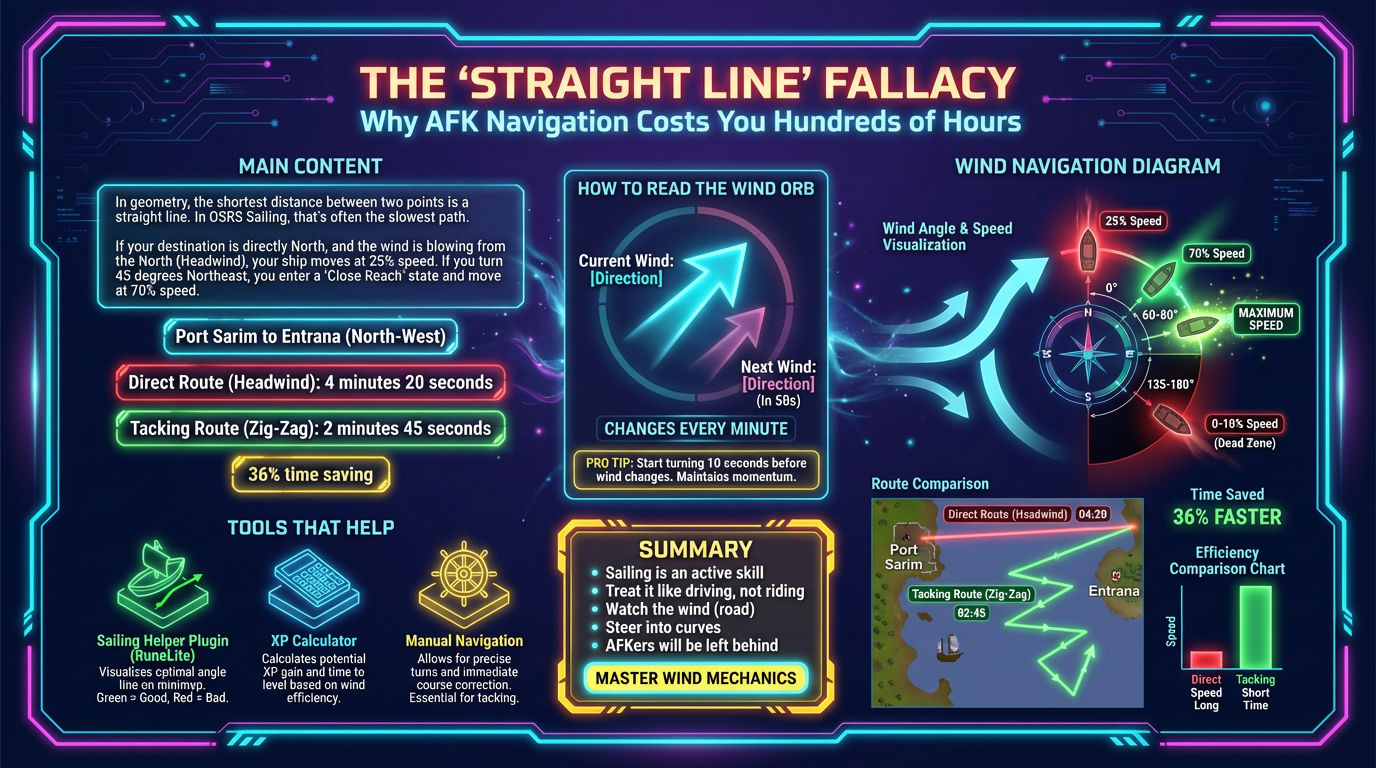
In geometry, the shortest distance between two points is a straight line. In OSRS Sailing, that's often the slowest path.
If your destination is directly North, and the wind is blowing from the North (Headwind), your ship moves at 25% speed. If you turn 45 degrees Northeast, you enter a "Close Reach" state and move at 70% speed.
We timed a trip from Port Sarim to Entrana (Directly North-West) during a North-West wind. Check out our detailed Wind Guide for more examples.
- Direct Route (Headwind): 4 minutes 20 seconds
- Tacking Route (Zig-Zag): 2 minutes 45 seconds
That is a 36% time saving just by clicking a few extra times. Over the course of a 1-99 grind, this saves you literally hundreds of hours.
How to Read the Wind Orb
The Wind Orb on your minimap isn't just decoration. The large arrow shows current wind. The small, faded arrow shows the next wind change.
Pro Tip: The wind changes every minute. If you see the next wind is going to be a Headwind, start turning 10 seconds before it changes. This maintains your momentum.
Tools That Help
If you are struggling, we recommend the "Sailing Helper" plugin on RuneLite. It draws a green line on the ocean showing the optimal angle. However, learning to do it by eye is more satisfying and allows for faster reaction times in combat. You can also calculate your travel times with our XP Calculator.
Summary
Sailing is an active skill. Treat it like driving a car, not riding a bus. Watch the road (wind), steer into the curves, and you will leave the AFKers in your wake.